
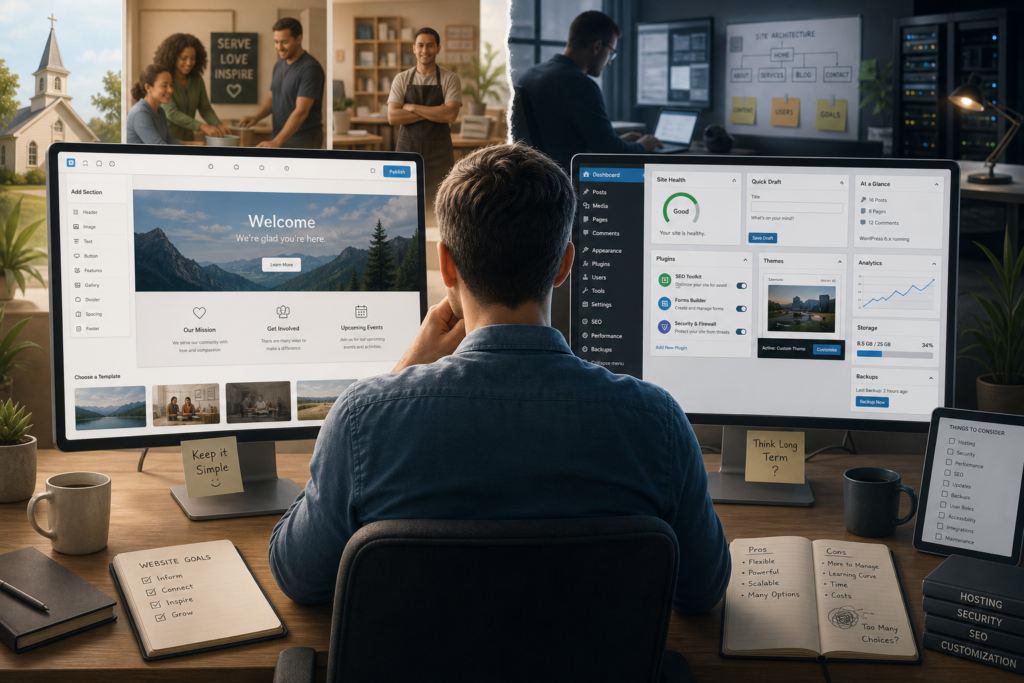
DIY Website Builder vs WordPress: Which One Should You Use for Your Small Business?
Choosing how to build your website can feel more confusing than it should.
You do not want to waste money. You do not want to get trapped in something too limited. You also do not want to spend weeks learning web design, hosting, plugins, security, backups, SEO, and domain settings just to get a simple website online.
That is where many small businesses, churches, nonprofits, and volunteer-led groups get stuck. The real question is not which platform is best. The better question is which website path fits what you actually need right now.
For most people, the decision comes down to two practical options: a DIY website builder or WordPress.
The simple answer
A DIY website builder is usually best when you need a simple website fast and want fewer technical decisions.
WordPress is usually best when you want more control, more flexibility, and a site that can grow over time.
Neither option is automatically better. The right answer depends on your budget, time, comfort level, and long-term plans.
What is a DIY website builder?
A DIY website builder is a tool that lets you create a website using pre-built layouts, guided setup steps, and simple editing tools. This can be a great fit if you need a basic site with pages like Home, About, Services, Contact, Events, Donations, Appointments, or simple product information.
The biggest advantage is simplicity. You do not have to think about every technical layer behind the site. Hosting, templates, and basic setup are often bundled together.
If that sounds like the path you need, start with the Cyber Grapes DIY Website Builder.
When a DIY website builder makes sense
A DIY website builder may be the right choice if you need your website online quickly, want to avoid plugin management, do not want to handle hosting decisions, are comfortable using templates, only need a handful of pages, or are building your first website.
This is especially helpful for people who were suddenly put in charge of a website for a church, club, local group, or small business. You may not be trying to become a web designer. You may just need the thing to work.
Where DIY website builders can fall short
The tradeoff is flexibility. A DIY website builder may start to feel limiting when you want advanced design control, custom functionality, complex SEO setup, special integrations, or full ownership of the website environment.
Some website builders are easy at first but harder to customize later. Others may bundle everything together in a way that makes moving away more difficult. That does not mean they are bad. It means you should choose them for the right reason.
What is WordPress?
WordPress is a flexible website platform that can support everything from simple business websites to larger content sites and online stores. With WordPress, you can control more of the website experience, including design, hosting, plugins, SEO, backups, security, forms, performance, and content structure.
That flexibility is the main reason people choose it. It is also the reason some people get overwhelmed by it.
If WordPress sounds like the better long-term fit, compare the Cyber Grapes DIY WordPress Hosting plans.
When WordPress makes sense
WordPress may be the better choice if you want more control over your website, plan to publish blog content regularly, care about SEO and long-term search visibility, need advanced forms or integrations, want room to grow, may eventually need ecommerce, or want a more customizable design.
For many small businesses, WordPress is the better long-term foundation. It gives you more room to build around your brand instead of fitting your brand into a limited template.
Where WordPress can get difficult
WordPress is powerful, but power comes with responsibility. You need to think about hosting, updates, themes, plugins, backups, security, spam protection, speed, SEO, and ongoing maintenance.
That does not mean WordPress is only for experts. It means WordPress works best when there is a clear plan. A simple WordPress site can still be very manageable when it is built with a clean theme, a reliable hosting setup, and only the plugins you actually need.
The real decision: simple now or flexible later
Choose a DIY website builder if your priority is getting online quickly, keeping things simple, avoiding technical maintenance, building a basic website yourself, and spending less time learning the system.
Choose WordPress if your priority is long-term flexibility, search engine growth, publishing helpful content, more control over design and features, and building a stronger digital foundation.
Both paths can work. The mistake is choosing one without being honest about what you need.
What we recommend at Cyber Grapes
At Cyber Grapes, we believe most people need one of two paths. Some people need a simple DIY way to get started without becoming a tech expert. Others need a webmaster who can help plan, build, manage, and maintain the site.
That is why we separate the decision instead of pretending one option fits everyone. If you want to do it yourself, start with the simplest tool that can honestly handle your needs. If you already know you need help, do not punish yourself trying to become a web developer on nights and weekends.
If you want Cyber Grapes to help build or manage the site for you, visit Hire a Cyber Grapes Webmaster.
Final recommendation
Choose a DIY website builder when you need a simple, guided path and want to launch quickly.
Choose WordPress when you want flexibility, control, and room to grow.
And choose help when the time you are losing is worth more than the money you are trying to save.
A website is not just a tech decision. It is a time, energy, and business decision.